A new wave of unrest in France
Robi Morder takes a look at why the government is pushing back at student protests in France for The Conversation.
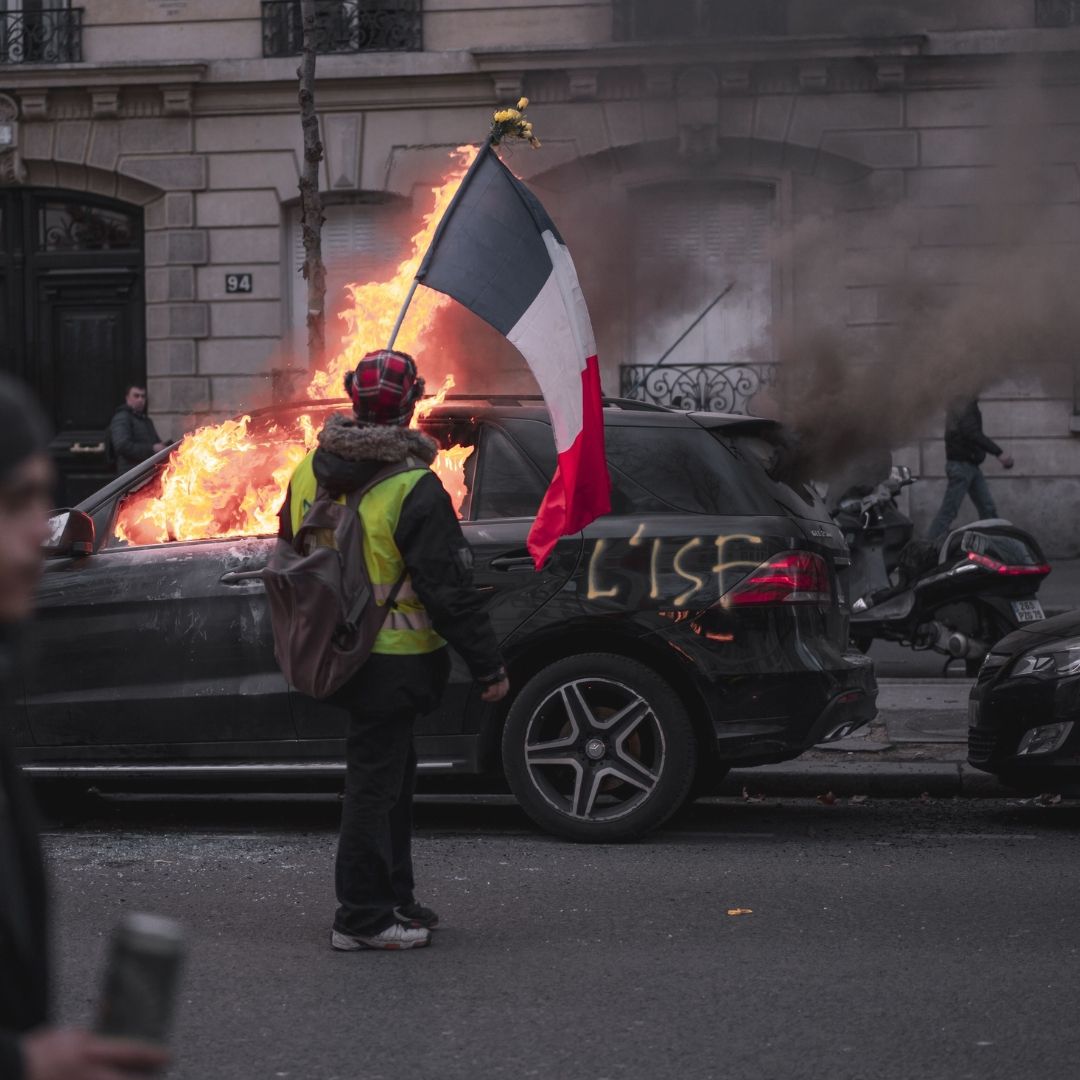
Image by Alotrobo | Pexels
Robi Morder is a member of the French Higher Education trade union and the non-profit Association Autogestion.
The mobilisation behind the high schoolers’ movement that began in the Paris suburbs, France, in September 2026 was in continuity with the back-to-school action in response to situations that were deemed to have worsened (absent teachers, overcrowded classrooms, dilapidated premises, etc) that secondary education had been experiencing cyclically since the end of the 1970s, contrasting with the type of spring uprisings that characterised the youth action of the period that was known as the 68 years.
In 1978, it was already noted that what had previously characterised technical secondary schools and vocational colleges (commonly known in France as LT and CET) had become a general problem for all high schools in the country.
“The school year of 1978 turned out to be a calamity, with overcrowded classes and a lack of teachers and staff. In Seine-Saint-Denis in the northern suburbs of Paris, there were doubts over whether school would ever be resumed. From September 15, with the backing of parent associations and many local elected officials, teachers at high schools in Saint-Denis and Noisy-le-Sec went on strike, calling for new teaching positions and classes to be opened,” an extract from Quand les lycéens prenaient la parole Les années 68 stated. “For the first time since May-June 1968, establishments in France were occupied day and night, particularly schools in Saint-Denis, Aubervilliers, and Montreuil (Greater Paris’ Seine-Saint-Denis Department).”
These recurring issues also gave rise to student uprisings in 1990 and 1998, leading then to significant measures that were considered victories. Movements occurring in the autumn had also affected high school students, but on other topics such as pension reform, the focus of a movement in 2010.
What was unprecedented in the autumn 2026 mobilisation was, first and foremost, the global context, with a war in Eastern Europe accompanied by an increase in military budgets that contrasted with a chronic shortfall in funding for education, a climate crisis that was affecting poorly insulated schools where high school students suffered from extreme heat and the prospect of a far-right presidential win in 2027. This last challenge may have been experienced as an existential threat by many high school students in working-class suburbs where the movement started.
How could students make their voices heard? To assert their demands, the options students had for taking action were limited. High school representation existed in law (students sat on boards of directors and within national institutions with the French Ministry for Education) but with little scope.
Apart from not being a right that high school students were entitled to, going on strike was simply time off and by no means a pressure tactic (a high school strike did not bother anyone and did not stop any production). As a result, for a high school movement to have any clout, deserting the classroom was not enough; students also needed to make themselves seen, heard, and media-friendly.
It was worth noting the shift in vocabulary over the last few decades. Picket had been replaced by block or blockade, especially since the high school movement against the Fillon law in 2005. The general assemblies that were held in high schools, deciding on strike pickets (filtering pickets or blockading pickets), had become more difficult to organise, especially when administrations did not allow them, sometimes simply because of the lack of classrooms. From then on, upper secondary establishments and administrations no longer talked about public secondary schools that were on strike but were counting the number of blockaded ones.
To be visible, students therefore needed to resort to spectacular action. Like every social group, high schoolers used what’s available to them: trash cans to block or slow down human traffic in front of high schools, holding demonstrations in their neighbourhood or town with prohibitive measures somewhat getting in the way; this was admittedly more difficult than calling on public figures (elected officials, for instance), likely to attract the curiosity of the media, protest signs, etc.
It was within this context that the issue of violence came into play. While we waited for more specific information about the profiles of the youngsters arrested, we did know that the vast majority of them were minors. But were they high school students or young people who had left, or been excluded, from the education system? The circumstances and the alleged facts may differ from one individual to another.
In the meantime, it was worth recalling that in the early days of May 68 in Paris’ Latin Quarter, there were a significant number of young workers who stood alongside students to seek revenge on the police for humiliating them on their council housing estates and in their neighbourhoods, according to French sociologist Gérard Mauger.
The current crisis blended the characteristics of high school student uprisings with those associated with the proto-political unrest in France’s suburbs, notably in 2005. The term suburban youth extended to high school students and other students, sometimes unemployed or living precariously. Their actions and reactions targeted their places of study, work, and where they lived. High school demonstrations were also places where people came together locally.
What was also singular was the way in which the public authorities had ignored the situation, while shortages of resources and staff were regularly reported, and once again that autumn, by teachers’ unions.
If governments in France since 2017 had experienced unprecedented conflicts, such as the Yellow Vest movement, the Sainte-Soline environmental protest rally (against a huge water reserve), urban unrest, and high school or student uprisings, they would have been recurrent and likely to be resolved through negotiation. However, since the loi travail legislation in 2016, the reaction of firmness by the authorities has seemingly become the norm, at the risk of violent clashes, making it dangerous to be present at protests even though they were legal. When applied to teenagers, it clearly appeared disproportionate and dangerous.
It seemed that, after ignoring the scale of the problems at hand, the choice of repression had prevailed. It was the French Interior Ministry that came to the fore, favouring mass closures of establishments nationwide. France had experienced some exceptional closures following past student movements, but never on such a scale.
After releasing a statement claiming political hijacking of the movement by France’s far-left party LFI due to the party’s show of strong support and the presence of its elected representatives outside institutions (while other parties did the same), the government’s rhetoric finally admitted that students’ demands were legitimate. Undoubtedly, public opinion in France, approving the legitimacy of the demands being made by high school students, would have strengthened the movement as well as the scale and the good behaviour of the October 6 demonstrations. The unions announced 450,000 protesters, whereas the ministry estimated 250,000 demonstrators nationwide.
But when there was negotiation, power dynamics came into play. What was possible before the student movement to try and calm the situation was proving insufficient at that point, especially as the mobilisation had been maintained and extended, and since the threat of an extension to students and a junction with other forms of discontent weighed heavily on the government. On social media, widely used by young people, many references were made not only to protests with other unions but also to October 17, a movement marking the return of the Yellow Vests. Somehow the bids were rising.
This article was originally published by The Conversation and can be found here.