CRJ 21:3 is live now!
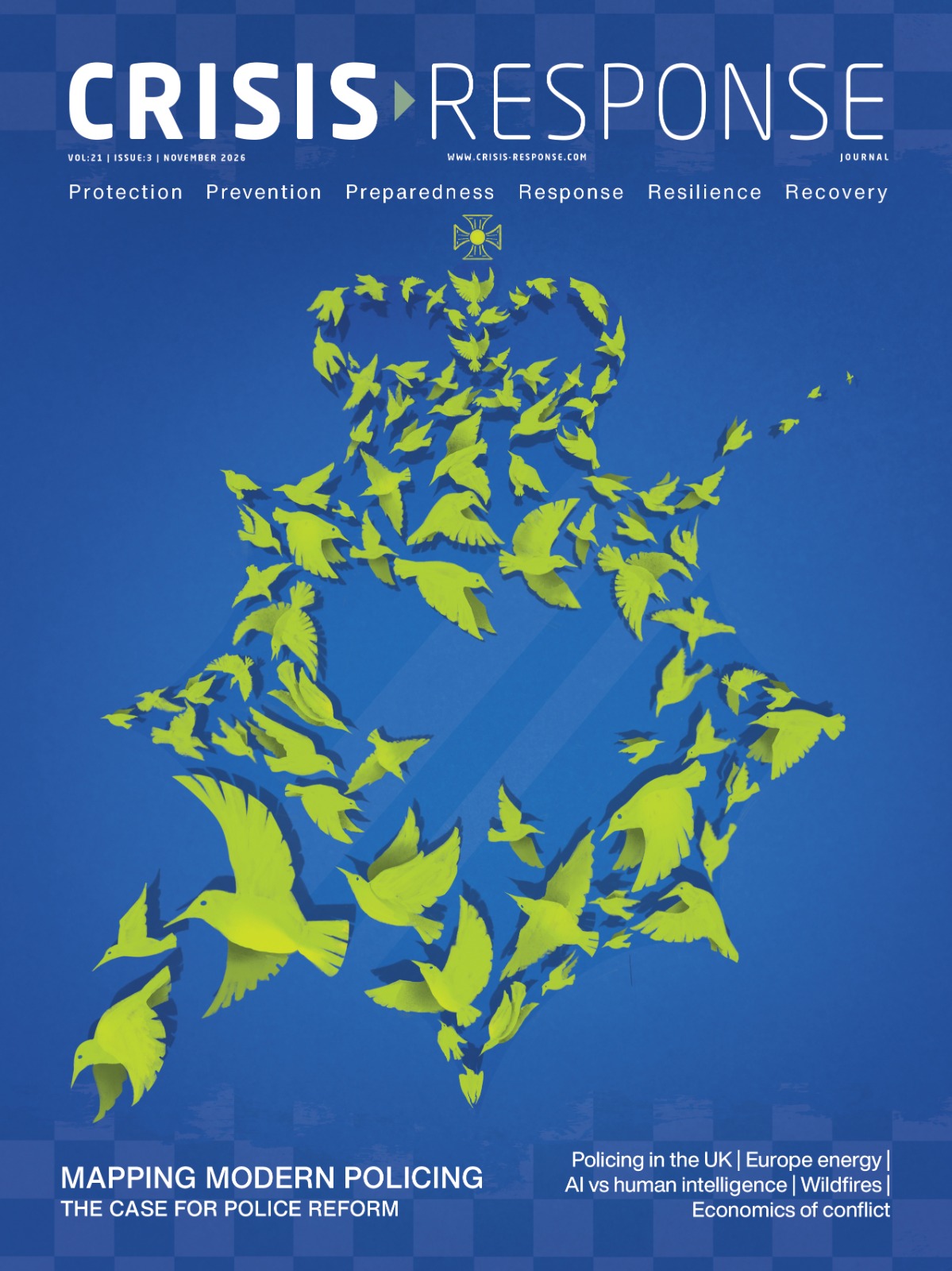 Our November 2026 Edition is now live. The digital edition can be accessed here on the CRJ website, whereas CRJ 21:3 hard copies will be mailed out shortly.
This edition’s cover story is ‘Mapping modern policing.’ Through a series of articles, our authors examine the reforms in policing, the need for a shift in leadership amid geopolitical developments, and responses to mega-hazards. The edition, essentially, explores the question: how can organisations, communities, and states adapt to an interconnected risk environment that remains beyond their control?
Comment: Mostafa Sayyadi explores a framework for including artificial intelligence in employee development and capacity building for organisations. Kelly McKinney draws on the 1949 Mann Gulch wildfire tragedy in the US to explore the importance of trust, collective sensemaking, and strong institutions in navigating the societal implications of artificial intelligence.
He writes: “In Mann Gulch, it was not a lack of courage that killed those young men, but rather that, once the crew dissolved, they lost what Weick called collective sensemaking. Every man ran from an idea he did not recognise. The way through the coming AI age will look just as strange, and a fractured public will run from it, just as the smokejumpers did. We will follow a counterintuitive approach only if we trust the person holding the match and the people running beside us.”
Mapping modern policing: Andy Blackwell investigates the new police reform in the UK and whether getting the blueprint right can mean a loss or win for the country’s national security. He writes: “A policing model with the resilience to tackle modern threats, the specialist depth to serve communities equitably, and the structural coherence that the 43 separate forces in England and Wales, under the current model, have never been able to provide. As we work through the details of this transition, the government must look beyond the balance sheet and listen to the officers on the beat. In my experience, real success will depend on bold leadership, proper resourcing, and a relentless focus on frontline delivery.”
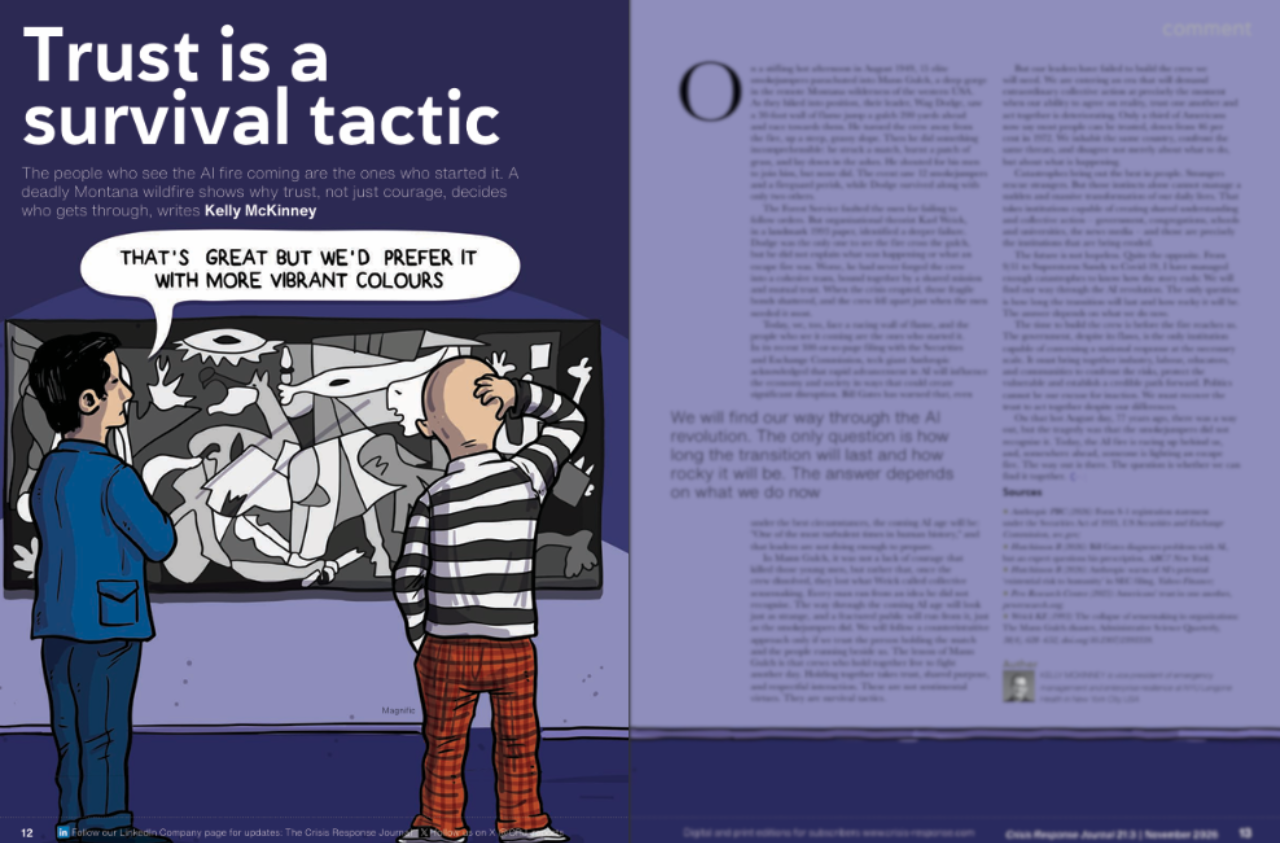
"Today, we, too, face a racing wall of flame, and the people who see it coming are the ones who started it" says Kelly McKinney (p 13)
Jasmine Jobber examines the implications of predictive policing for public trust. Luavut Zahid investigates why, despite decades of warnings and hundreds of recommendations, the systems meant to protect children continue to fail victims of grooming gangs in the UK. Shayoni Lynn examines the information environment in which public sector organisations now operate, analysing how false narratives took shape after the murder of Henry Nowak in the UK.
Onto security for a modern conflict: Harel Ram notes how the democratisation of military technology is shifting the balance between attackers and defenders while Jacob Jefferies explores how counter-insurgency campaigns must adapt to the changing character of modern conflict.

Richard Dempers and Joe Yaeger consider what recent incidents reveal about vulnerabilities between organisations, systems and jurisdictions in an era of hybrid threats (p 32)
For many of our authors, the nature of leadership and its systems must adapt to the current levels of uncertainty. Cedrick Moriggi urges organisations to consider the strength of their interconnected resilience networks. He writes: “Resilience is not something you declare. It is something you build or erode together with your ecosystem and your wider stakeholders. Everyone remembers the Three Little Pigs. The house of straw fell first, the house of sticks second, and the house of bricks held. What the story forgets to tell you is the more interesting part: The wolf did not care what each pig believed about his own house. Ask yourself this: If you were the wolf, which house would you choose to blow against? Most companies answer that question in a strategy deck, and few answer it honestly when the wind arrives.”
Philippe Borremans sheds light onto the growing operational risks for businesses owing to global geopolitical developments, and the need for crisis communication to evolve alongside them, while Richard Dempers and Joe Yaeger highlight how hybrid threats exploit vulnerabilities between organisations, systems and jurisdictions.
Beverley Griffiths and Gail Rowntree explore resilience as both a theoretical concept and a practical capability in their book, Resilience in Emergency Management: Core Concepts and Practical Applications. For Araba Cole, leadership in the resilience space is often associated with taking charge during a crisis or moments; however, the quality of that response depends on the work done ahead of the crisis.
Katherine Sykes introduces the Crisis Communications Network’s new volume A Handbook for Good Governance, offering practical guidance on understanding and addressing crisis as a continuous organisational responsibility and a whole-system challenge. Roger Gomm analyses the UK’s 2026 National Risk Register and its implications for local resilience.
Amanda Coleman looks at the importance of creativity in communicating – and responding – to crises in the context of social media and artificial intelligence. “Artificial intelligence is increasingly being used to develop creative communication, but a quick look through social media shows that it can become formulaic, and there is a risk of being overwhelmed by AI slop. AI does bring many opportunities, but without attention to the audience and what they need, everything gets produced in a homogeneous way,” she writes. “There are many barriers to being creative, such as the culture of the organisation and the views of senior managers. But the biggest obstacle to making a difference through images, music, artistic endeavours, or gamification is communicators’ own biases and ideas of what crisis and risk communication should be.”
Amanda Coleman's article on the need for creativity in crisis communication (p 92)
Juan Muñoz draws leadership lessons from General Dwight D Eisenhower, the Supreme Commander of the Allied Expeditionary Force, while Jasmine Jobber speaks to Inderjit Singh about his experience overseeing operations at one of the world’s busiest airports.
Felix FitzHugh notes that human oversight hasn’t gone obsolete yet, especially in the case of business continuity documents produced by artificial intelligence. In the same lens, Raphaël de Vittoris, Carole Bousquet, and Benoit Vraie put the use of artificial intelligence in crisis anticipation to the test, comparing it with real crisis teams.
Looking at cascading crises: Gilles Paché examines the logistical operations behind the July 2026 wildfires in France and other major fires around the world. He writes: “The Gironde crisis of late July 2026 can be understood as a highly constrained form of reverse logistics. In a conventional supply chain, goods move towards consumers. During a mass wildfire evacuation, the logic is reversed: the priority is to move the population out of danger while simultaneously moving the resources required for firefighting into the affected area. Two opposing flows must therefore operate simultaneously.”
Erik de Soir provides an effective evacuation response in the case of residential fires in multi-story buildings while Jeroen Steenbakkers argues that effective evacuation planning requires moving beyond static consultancy reports to transparent, reusable simulation tools.
Meanwhile, Joshua WJ Brown revisits the 2003 North American blackout – and its development into a hazardous event for Ontario, Canada’s Chemical Valley. And Zainab Farooqui analyses the pendulum of Europe’s energy systems – in between renewables and fossil fuels – and whether the system is truly ready for a clean transition.
Heather Stem and Tasha Whitear explain how preparedness exercises can help organisations evaluate and strengthen their crisis response capabilities.
Sarah Adams looks at the use of forecasting, satellite imagery, autonomous systems, and real-time sensor networks for response, and David Mariscal Fernández introduces his public-beta crisis information and recovery co-ordination tool, CrisisWeave.
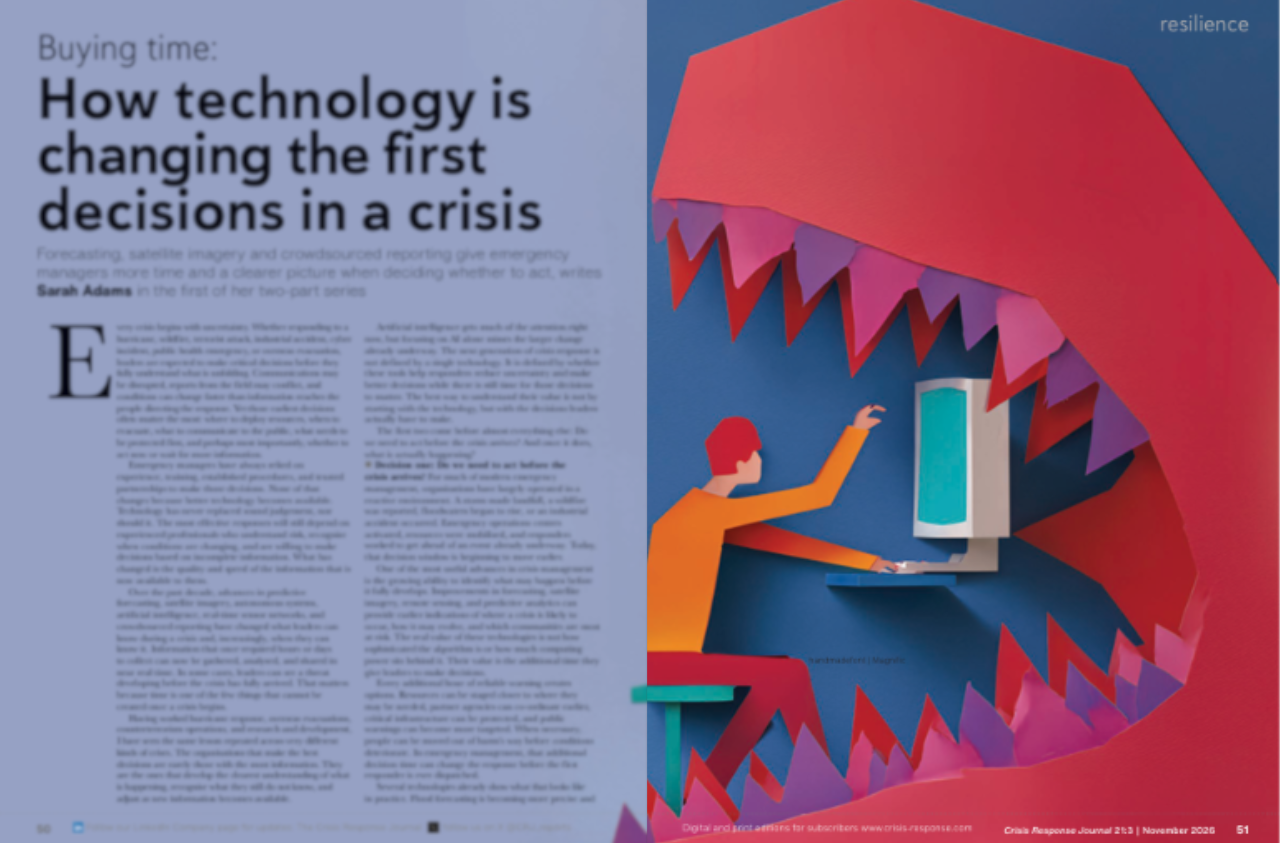
"Emergency managers have always relied on experience, training, established procedures, and trusted partnerships to make those decisions. None of that changes because better technology becomes available," writes Sarah Adams (p 50)
Frontline: Zainab Farooqui speaks to Adam Hopper about his work as the national ambulance violence prevention and reduction programme lead for the Association of Ambulance Chief Executives, exploring the importance of data in understanding and mitigating violence against frontline workers in the UK.
On October 6-7, 2026, the Resilience World Nexus Summit concluded at Church House Westminster, London, bringing together more than 470 participants from over 275 organisations across 24 countries. The summit will return to Church House Westminster on October 4-6, 2027, with three days of keynotes, plenaries, masterclasses and thematic tracks.
The Crisis Response Journal is available to subscribers only – we have a range of subscription rates to suit all needs. Click here for more details, or contact us at hello@crisis-response.com – we would love to hear from you!
Read CRJ 21:3 here!