CRJ 21:1 is live now!
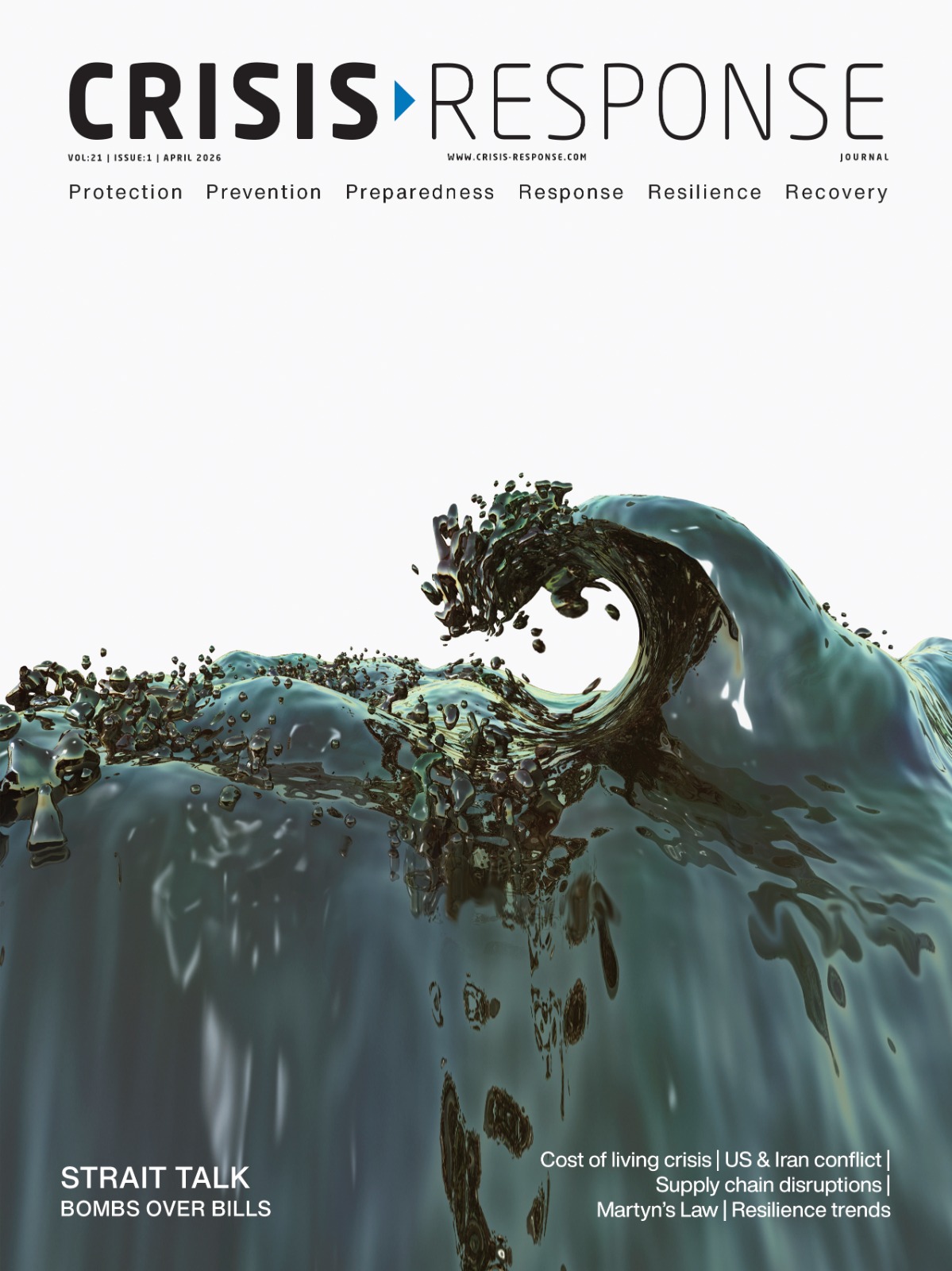 Our April 2026 issue is now live. The digital edition can be accessed here on the CRJ website, whereas CRJ 21:4 hard copies will be mailed out shortly.
This edition’s cover story is ‘Strait Talk.’ Through a series of articles, our authors examine geopolitical tensions and competing narratives in the US-Iran conflict while also highlighting how nations and organisations are adapting to an increasingly multi-vector crisis environment. It also explores emerging risks, emergency systems, response approaches, and crisis leaders in an era of increasingly complex global crises.
Comment: Lyndon Bird reflects on trends in resilience, noting that it must sit at the heart of organisational decision-making.
Language evolves with time and grows heavier. Matt Minshall argues that countries avoid the legal weight of declaring ‘wars’ to sidestep accountability and enable prolonged conflict, while Tim Toulmin warns inflated language dilutes the meaning of terms such as ‘toxic’, making organisations misdiagnose routine tensions as crises.
Onto Strait Talk: Kunwar Khuldune Shahid reports on the shift in energy supplies and routes owing to the US-Iran conflict. Meanwhile, Noureddine Idrissi looks at the media framing of the conflict, where both the US and Iran position each other as the aggressor while legitimising their own actions. He asks: “In a context where conflict partially shifts into the informational space, under what conditions can a narrative become a durable and legitimate interpretative framework?”
As physical security, cyber risk, and operational continuity become central to crisis management, Paolo Napolitano reports on how businesses in the Gulf are adapting to a more volatile operating environment shaped by the US-Iran conflict.
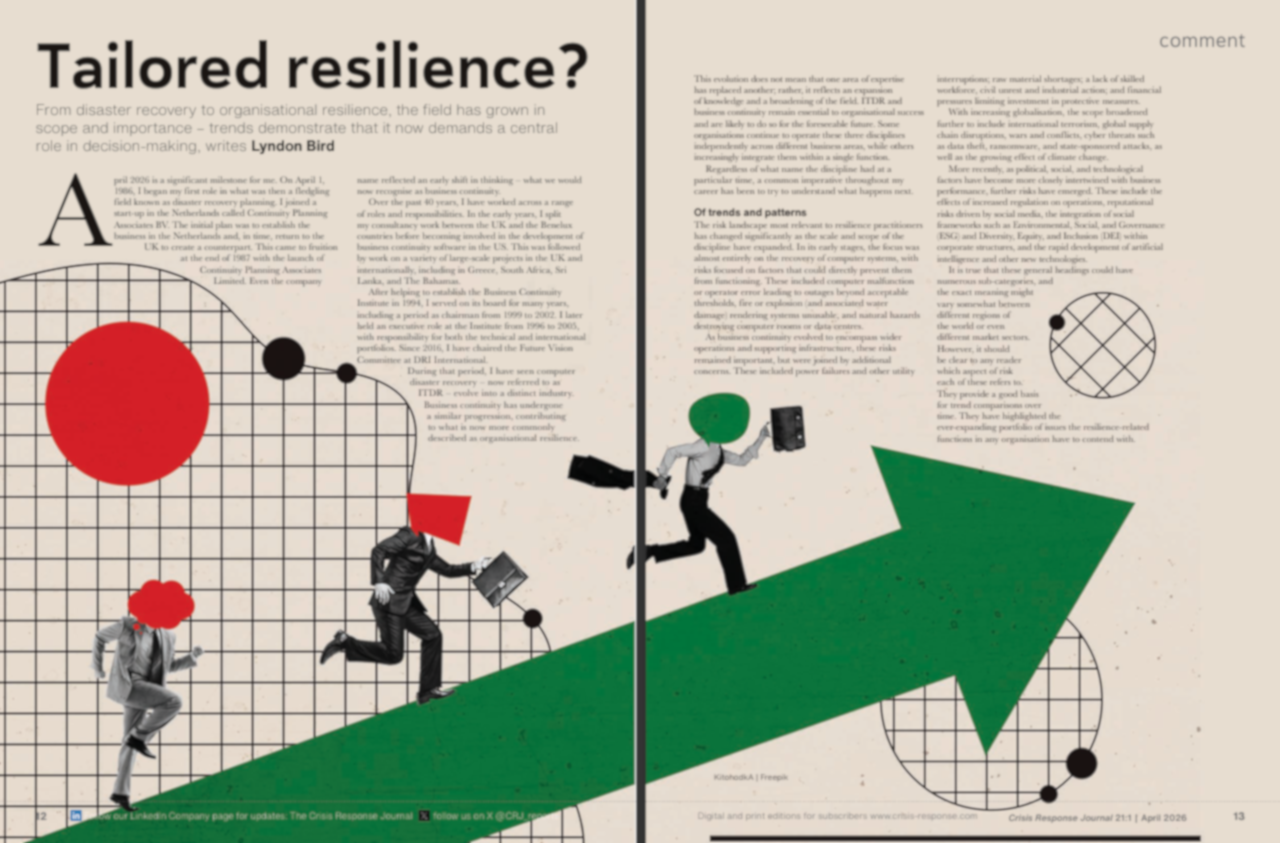
Lyndon Bird writes: "Resilience must sit at the highest levels of the organisation. It needs to encompass both preventative measures and reactive capabilities, but, more importantly, it requires the development of strong organisational foundations" (p13)
Cedrick Moriggi takes it a step forward, presenting how the three vectors of attack in crises are at play in the Gulf currently. He adds: “Pull out your 4x4 risk matrix. Plot the scenarios. Assign the probabilities. Then ask yourself, does any of this help me understand what the new operating environment looks like or what I need to build for it? The honest answer, for most organisations operating in or connected to the Middle East right now, is no.”
Meanwhile, Kelly Blakeley writes that regional vulnerabilities are interconnected, emphasising the importance of a cross-border approach to continuity.
Onto broader crises: Andy Blackwell assesses how the rising cost of living has knock-on effects on social stability, community resilience and service continuity. If people can’t afford their lives, can they afford to contribute to civil protection mechanisms? This makes Roger Gomm’s article more of a warning, as he notes that amid geopolitical tensions and economic disruptions, the most effective response continues to be community resilience.
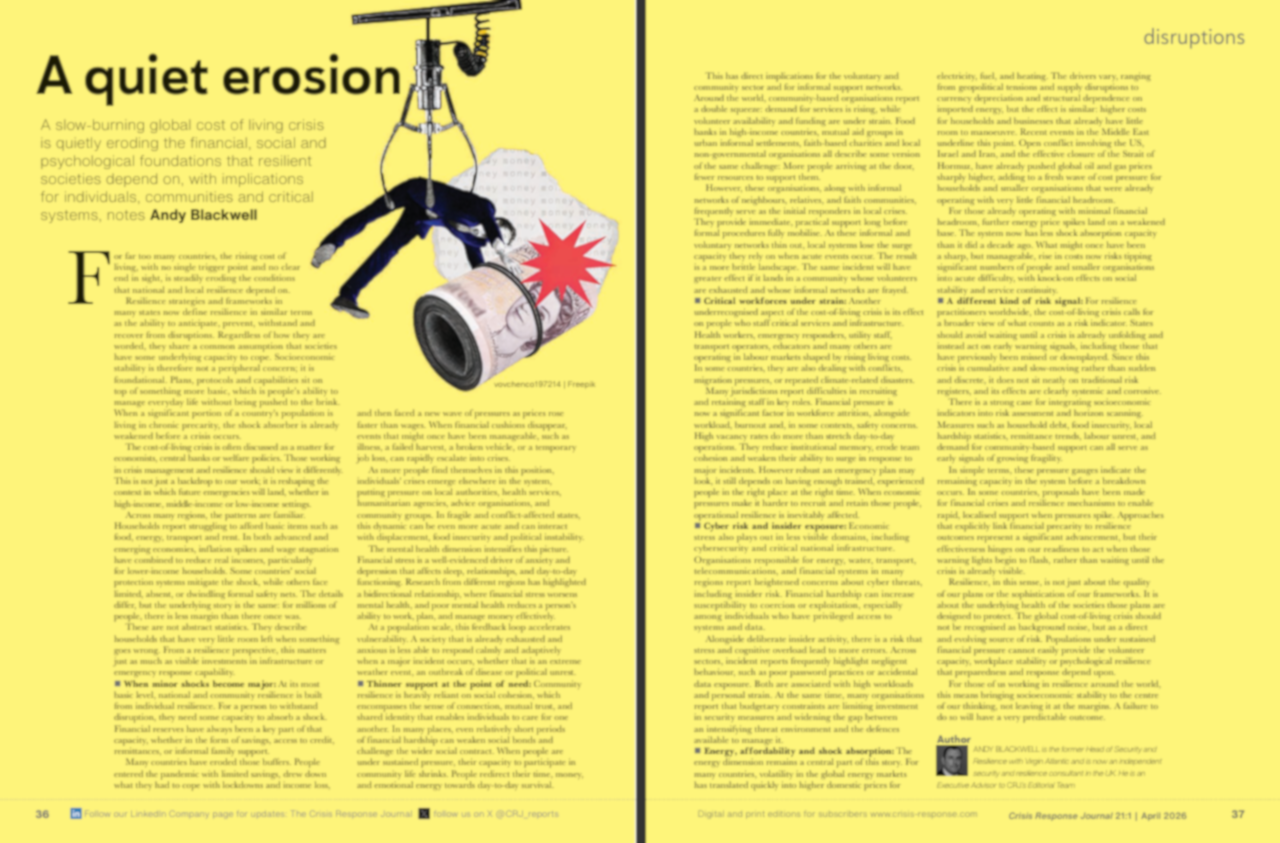
The rising cost of living, with no single trigger point and no clear end in sight, is steadily eroding the conditions that national and local resilience depend on, says Andy Blackwell (p36)
Gilles Paché addresses the high vulnerability of green European industries to external shocks driven by intensifying economic rivalries and climate-related disruptions. Looking at agrifood in particular, Alireza Asgari explores how these supply chains can build multi-level resilience amid disruptions. On a similar note, Matt Minshall and Zainab Farooqui analyse the US’ proposed framework of a future deal, its responses and implications for the global rules-based order.
Amanda Coleman’s survey of women in crisis management and resilience explored experiences of inclusion and participation in decision-making environments. She found that: “Both men and women reported that women are more likely to be interrupted or spoken over, with three-quarters of women (75 per cent) and 58 per cent of men observing this. Similarly, 66 per cent of women and 42 per cent of men said they had seen a woman’s idea initially overlooked, only to be accepted when repeated by someone else. Most respondents also agreed that an assertive woman is more likely to be labelled as aggressive or bossy.”
Response efficiency: This edition also looks at emerging risks and how we can test and trust existing systems in place. Fahri Gürcan explores how artificial intelligence can be applied as a decision-support layer in emergency call systems, while Sean Cunningham introduces the ‘high five’ framework for decision-making in crisis leadership.
Alessandro Saviolo spotlights testing protocols of drone systems, questioning the focus on if they can complete simulated tasks rather than if they can remain reliable, interpretable and safe in a real crisis.
Similarly, Victoria Kluge argues that decision degradation is the hidden failure in safety-critical systems. She writes: “The resilience of any high-stakes system is determined not by structural strength alone, but by the integrity of the decisions made within it. Too often, resilience is measured in visible coherence of operational activity. These indicators are essential, yet incomplete. Resilience is not redundancy or structural robustness in isolation; it is the disciplined preservation of authority clarity.”
Guy Collins, Jane Mary Hager, Pat Deeny and Dr Nigel Taylor examine the need for education aimed at enhancing transcultural competence in humanitarian aid and disaster response.
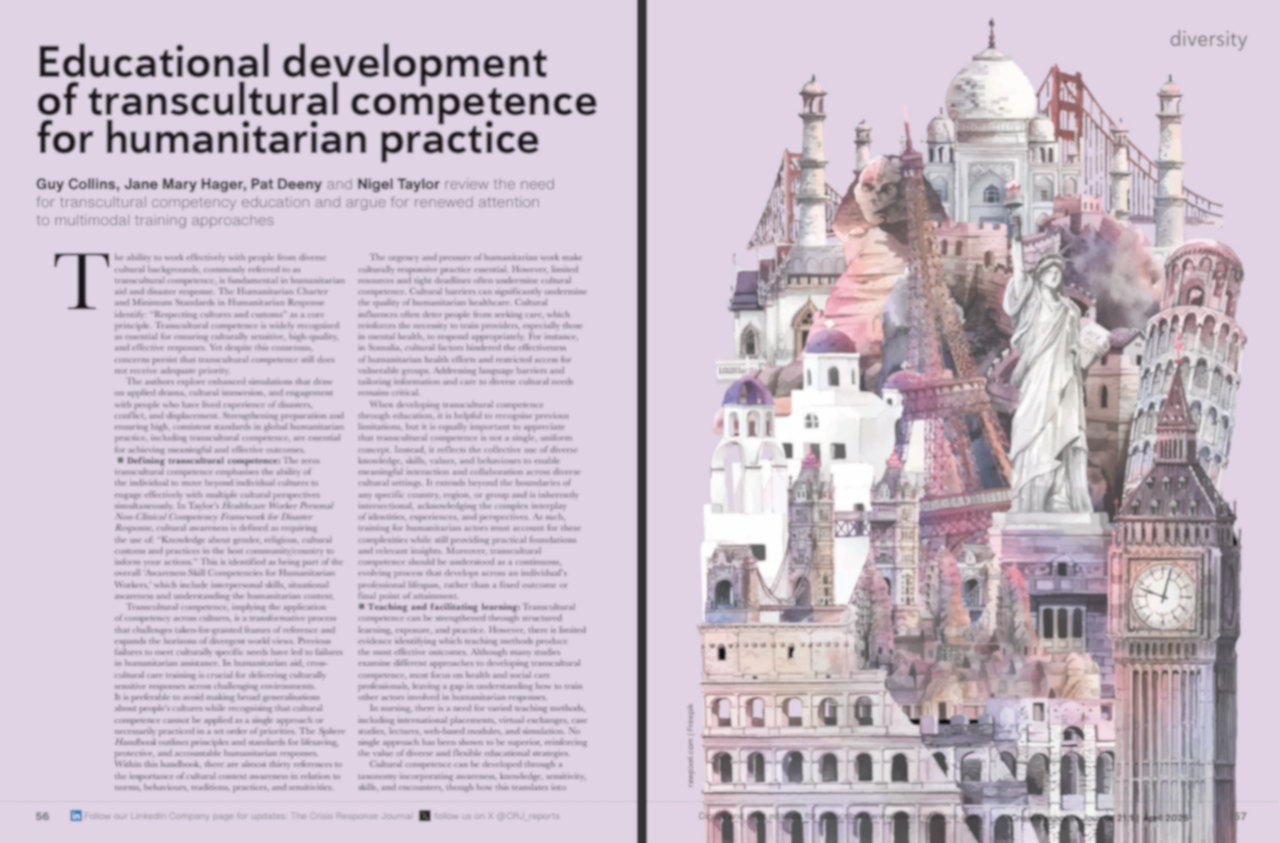
Guy Collins, Jane Mary Hager, Pat Deeny and Dr Nigel Taylor explore enhanced simulations that draw on applied drama, cultural immersion, and engagement with people who have lived experience of disasters, conflict, and displacement (p56)
Public safety: Yael Blanka Rauová and Steven B Goldman look at how Jewish communities in Europe require a shift away from physical security to integrated, cross-border resilience governance.
Erik LJL de Soir draws lessons in safety from survivor testimonies and eyewitness accounts of the fire at the Le Constellation bar in Valais, Switzerland. Similarly, Kyle Knappenberger presents an alternative early-response approach to chemical incidents using dry decontamination.
Amanda Coleman speaks to Figen Murray about her journey to the development of Martyn’s Law. Kaan Ozbay, Jingqin Gao, Zilin Bian, Fan Zuo, and Rui Ma introduce their AI-power digital twins for traffic management and public safety.
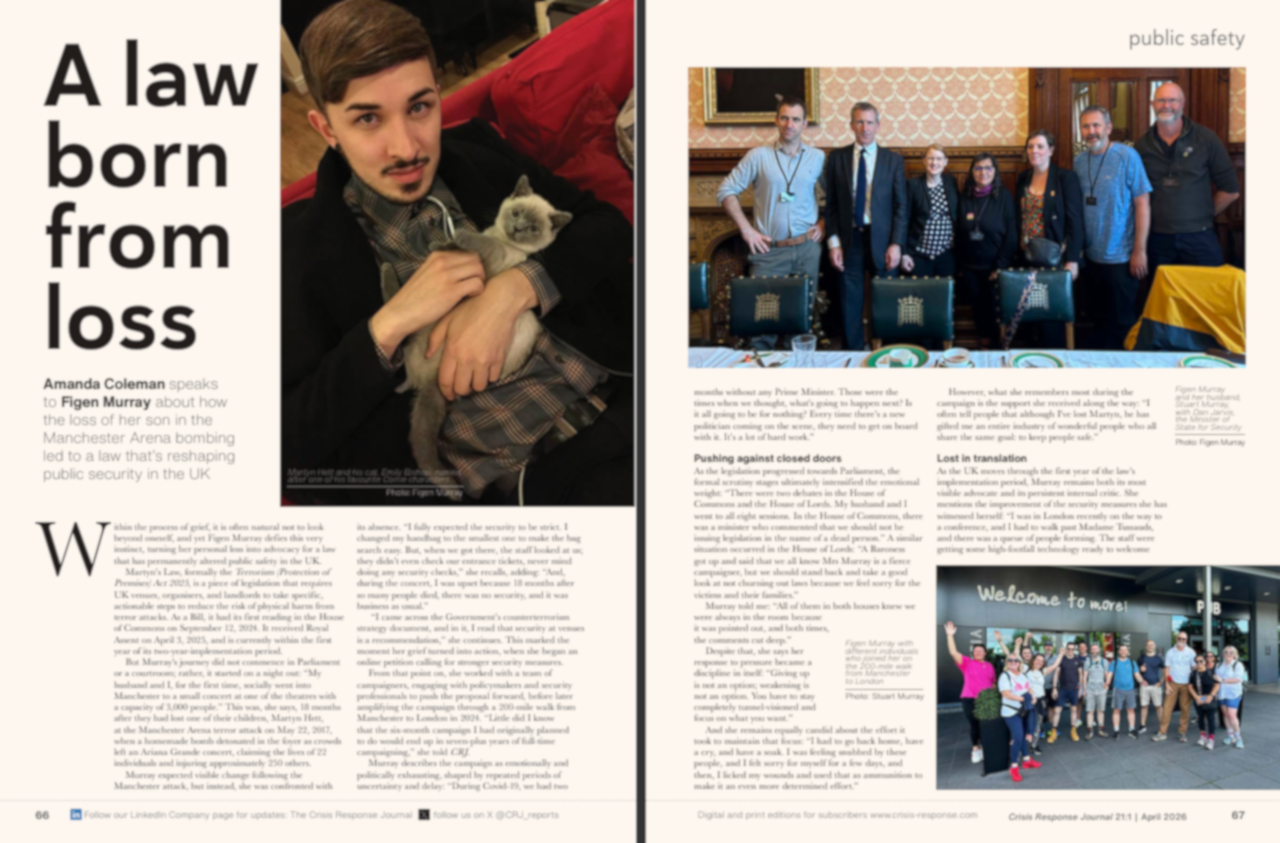
On p66, Amanda Coleman writes: "Within the process of grief, it is often natural not to look beyond oneself, and yet Figen Murray defies this very instinct, turning her personal loss into advocacy for a law that has permanently altered public safety in the UK."
On leadership and language: Tony Jaques questions the relevance of military books to modern business and crisis management. He writes: “Are military leaders really the best role models, or simply the most visible? Crisis managers might gain equally meaningful, and possibly more relevant, insights from polar explorers, mountaineers, astronauts, or even sporting figures.”
Lucy Stone asks a critical question: When new risks keep emerging and regulatory expectations shift every quarter, how do organisations keep teams engaged without burning them out?
On the topic of new risks, Michael J Provitera and Mostafa Sayyadi introduce learning approaches to help leaders evolve from control-based expertise to soft, people-centred leadership in an era of AI-disruptions. Caroline Sapriel and Anne Pappas explore the issue of optimism bias in crisis leadership.
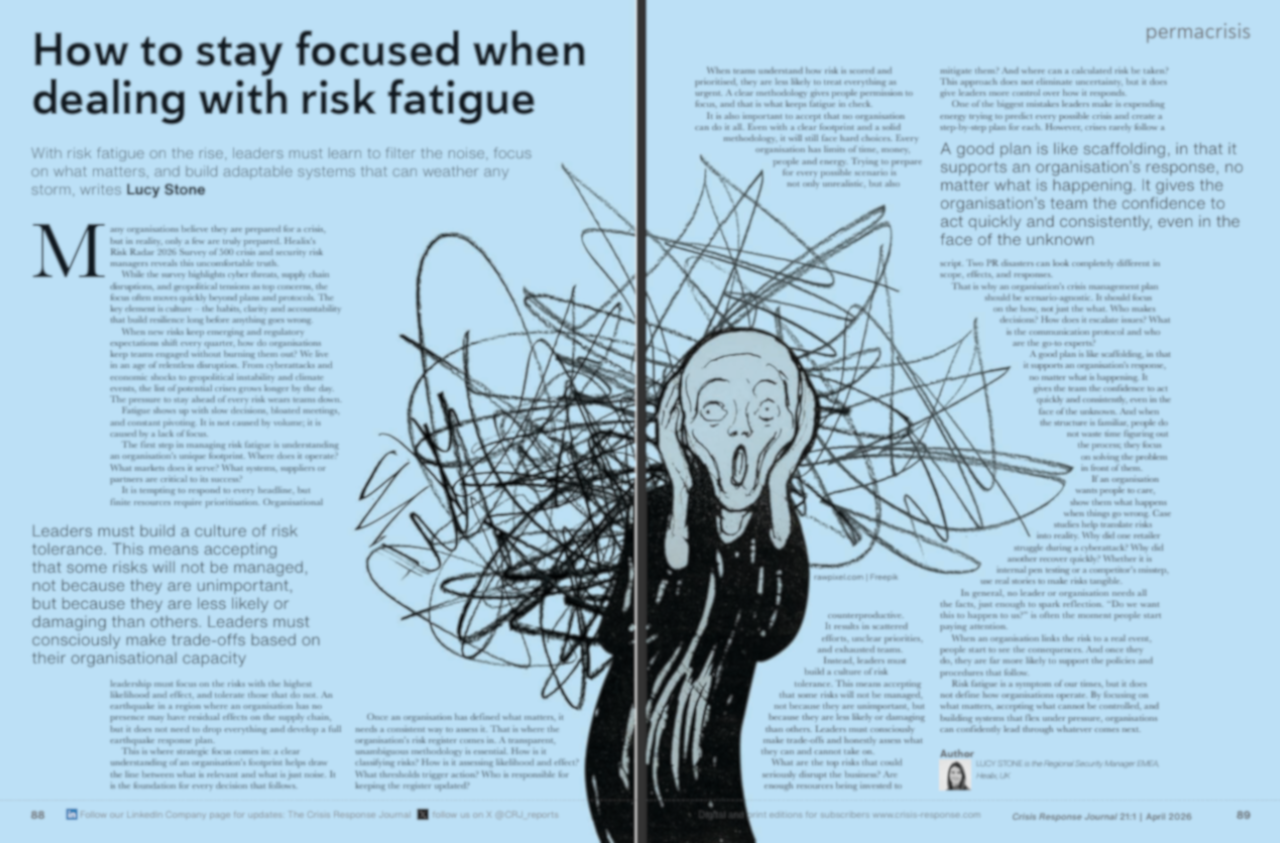
When new risks keep emerging and regulatory expectations shift every quarter, how do organisations keep teams engaged without burning them out? asks Lucy Stone (p88)
Zainab Farooqui exposes the hidden environmental toll of modern conflict, tracing its direct and indirect climate costs. She writes: “Yet, any attempt to estimate military emissions runs into a fundamental obstacle, which is a lack of official numbers. Despite a treaty to limit greenhouse gas concentrations, the United Nations Framework Convention on Climate Change indicates that reporting on such is voluntary, and as a result, data is often absent or incomplete.” Meanwhile, Samantha Burgess presents an interactive web-based application for monitoring heat and cold stress across the globe.
Frontline: Zainab Farooqui speaks to Richard Adams about his journey to founding New Zealand’s first veteran-led disaster relief organisation.
Geo Week 2026 highlighted how advances in geospatial technology are enabling faster, more co-ordinated disaster response, says Carla Lauter.
Sarah Marie Wiebe explores her book Hot Mess: Mothering through a Code Red Climate Emergency, where she talks about her experience of living through a polycrisis as a new mother and the politics of care in emergencies.
The Crisis Response Journal is available to subscribers only – we have a range of subscription rates to suit all needs. Click here for more details, or contact us at hello@crisis-response.com – we would love to hear from you!
Read CRJ 21:1 here!